Human-aware, accessible, and adaptive intelligent systems.
BAT Lab research examines how people interact with intelligent systems, how technology can accommodate differences across users, and how interfaces can adapt their communication and behavior in real time.
BAT Lab research ecosystem
Three research areas. One human-centered agenda.
We study how intelligent technology understands people, broadens access, and communicates through adaptive interfaces.
Collaborative intelligence
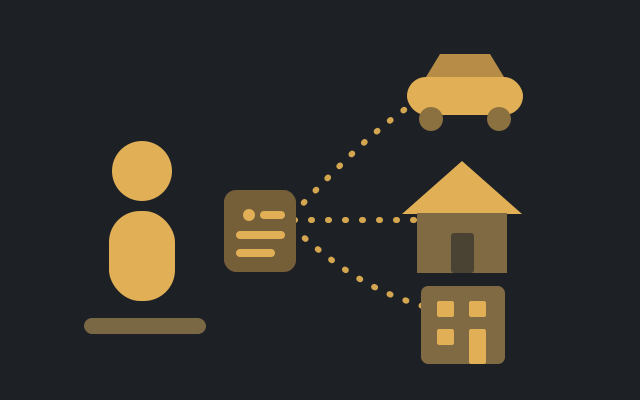
Human–Intelligent Systems Interaction
Understanding how people and intelligent systems share information, control, and responsibility.
Human-aware
Mental States
Trust
Wellbeing
Intelligent Systems
Automated Vehicles
Smart Office
Smart Home
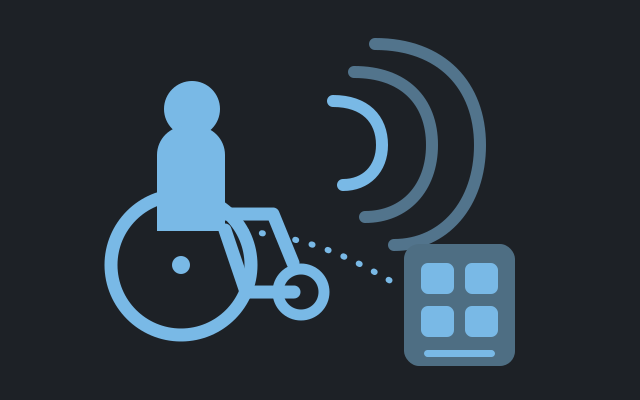
Empowering access
Assistive Technology & Accessibility
Designing technology across age, ability, sensory function, cognition, and mobility.
Aging and Disability
Non-chronological age
Cognitive differences
Hearing loss
Mobility limitations
Assistive Technology
Mobility
Smart workplace
Healthcare robotics
Personalized education
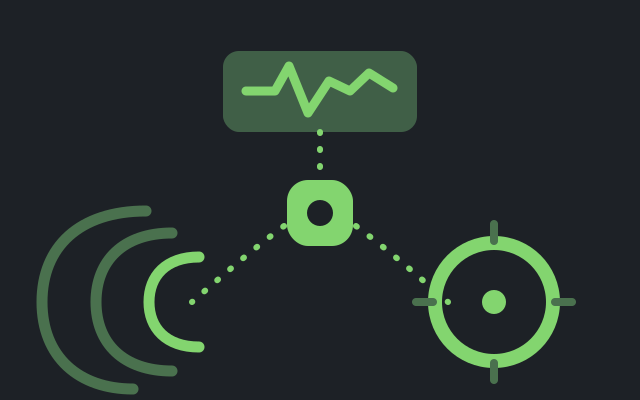
Seamless interaction
Adaptive Human–Machine Interfaces
Adapting how intelligent systems communicate according to the user and real-time context.
Multimodal HMIs
Visual Display
Auditory Display
Tactile Display
AI-Driven
Adaptive
Real-time
Wearable
Emerging connections
Ideas that travel across the research areas
Collaboration framework
Triadic Human-AI Collaboration Framework
The framework describes real-time collaboration through Advisor, Co-Pilot, and Guardian roles. It also informs when adaptive human–machine interfaces should explain, share control, or intervene.
Embodied intelligence places AI within physical systems that sense, communicate, and act. Current applications include mobility, education, smart homes, workplaces, and assistive technology.
Research questions
Explore one research area at a time.
Each area is anchored by a distinct set of questions about how intelligent systems understand people, broaden access, and adapt in context.
Human–Intelligent Systems Interaction
This pipeline examines how people interact and collaborate with automated and AI-enabled systems, particularly in time- and safety-critical settings. Current work studies human states, trust, well-being, and the transfer of roles between people and intelligent systems.
Human-state estimation
Trust and well-being
Human-AI roles
Intelligent mobility
Smart environments
Current research questions
How can intelligent systems estimate human state without creating unnecessary burden?
When should AI provide information, share control, or intervene?
How can people and intelligent systems transfer responsibility clearly?
Assistive Technology & Accessibility
This pipeline develops technologies for diverse users across age, ability, and mobility contexts. The research accounts for individual differences through wearable support, accessible mobility, smart environments, healthcare applications, and personalized technology.
Non-chronological age
Cognitive and sensory variation
Mobility and navigation
Smart environments
Healthcare robotics
Current research questions
Which differences among users affect technology use and task performance?
How can assistive technology be tailored while preserving user agency?
How can AI support mobility, independence, safety, and well-being?
Adaptive Human–Machine Interfaces
Human-machine interfaces connect people and intelligent systems. This pipeline develops visual, auditory, tactile, and wearable interfaces that can adapt their modality, timing, intensity, pattern, and placement according to human states and the surrounding context.
Visual displays
Auditory displays
Tactile displays
Wearables
Real-time adaptation
Current research questions
Which modality communicates urgency and meaning most effectively?
How should an interface adapt to human state, task, and environment?
When should an interface communicate, assist, or trigger physical action?
Research network
Research grows through collaboration.
We work with academic, public, nonprofit, and industry partners to translate human-centered research into practical impact.